When a government agency or institution scores a demolition RFP, it does not just check your price. It checks whether you actually qualify. If you manage a commercial property, you may only discover this gap after your bid gets rejected on paperwork instead of price. By then, your project timeline has already slipped.
Commercial demolition contractors who hold MBE certification solve a problem that generic licensing does not. They let you meet minority-business procurement requirements while you still get a fully licensed, OSHA-compliant demolition crew.
This article shows you what that certification covers, what else to check before you sign a contract, and how Elkanah Remodeling Co. fits into that process for buyers evaluating commercial demolition contractors in New York City.
For government and institutional work, buyers should verify the contractor’s applicable license and demolition endorsement, safety compliance, and MBE certification requirements for the specific procurement.
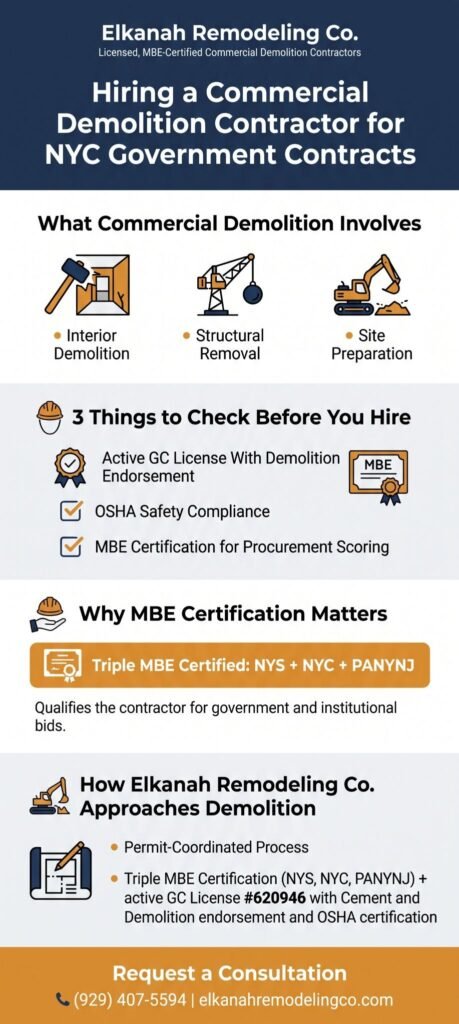
When you hire commercial demolition contractors for a public-sector project, the work covers structural removal, interior strip-outs, and site preparation, and it only moves forward once your permits and safety documentation are in place.
Core Scope of the Work
Commercial demolition on an institutional or government project usually includes interior demolition, structural removal, and site preparation ahead of a buildout. Crews strip out drywall, flooring, and fixtures first.
Structural elements like load-bearing walls or concrete slabs may require additional engineering review and permitting before removal.
A full demolition filing must satisfy the permit and endorsement requirements outlined in the NYC DOB NOW: Build Full Demolition Resources, including a demolition-endorsed general contractor as the applicant of record.
Site preparation follows once the permit clears, and your contractor should confirm this filing status before scheduling any crew on site.
Skipping any of these steps out of order creates delays that public-sector timelines rarely absorb. You avoid that risk by confirming the sequence with your contractor before work starts.
What Agencies and Institutions Get Wrong When Scoping a Demolition RFP
Some demolition RFPs may focus heavily on pricing while also including specific licensing, safety, and procurement requirements. This creates a mismatch: the winning bid looks affordable on paper but cannot legally start work because the contractor lacks a demolition-specific license endorsement.
The NYC HPD Pre-Qualified Demolition Contractor List identifies pre-qualified demolition contractors and indicates whether each listed firm has MWBE status. That gap is exactly why credential screening belongs at the top of your RFP process, well before you compare pricing between bidders.
Scoping your demolition RFP around compliance requirements first prevents this mismatch before it costs you a delay. When you check license endorsements and certifications before requesting quotes, you avoid this problem entirely.
The right commercial demolition contractor for your public-sector project holds a demolition-endorsed license, documented OSHA compliance, and MBE certification that counts toward procurement scoring.
An Active License With a Demolition-Specific Endorsement
New York does not issue a single statewide contractor license. In New York City, the NYC Department of Buildings requires registered general contractors to carry a safety endorsement for construction, concrete, and demolition work on buildings four stories or taller.
Confirm this endorsement exists before your contractor sets foot on site, not after.
OSHA Compliance and Safety Documentation
Demolition carries specific hazards that standard construction work does not, including structural collapse risk and hazardous material exposure.
Federal demolition standards under OSHA 1926 Subpart T require an engineering survey before work begins and set specific rules for mechanical demolition and material removal. Ask for documentation of applicable safety training and procedures before work begins.
MBE Certification as a Procurement Qualifier
Government agencies and many institutions score bids partly on whether the vendor holds minority business enterprise certification. The NYC Small Business Services M/WBE Certification Program exists specifically to help certified firms access city contracts and grow through them.
This criterion gets skipped in most contractor research. You may evaluate license and safety credentials closely, then treat MBE status as a minor detail rather than a scoring factor that can decide whether your bid even qualifies for review.
Elkanah Remodeling Co. gives you a commercial demolition contractor that coordinates permitting directly with NYC Department of Buildings requirements and holds triple MBE certification that few small Bronx-based contractors carry at once.
A Coordinated Process From Permit to Punch List
Elkanah Remodeling Co. treats demolition as the first coordinated phase of your larger commercial buildout, not a standalone task. On the corporate warehouse remodel project at 35-21 Vernon Blvd in Queens, the team sequenced interior demolition around permit approval.
Coordination continued directly with the project’s structural plans before any structural removal began. That sequencing is what keeps your demolition phase from stalling a commercial timeline.
Certification That Opens Government and Institutional Contracts
Elkanah Remodeling Co. holds minority business enterprise certification from New York State, New York City, and the port authority of New York and New Jersey at the same time.
The state-level credential is issued by the Empire State Development Division of Minority and Women’s Business Development, which certifies firms for New York State agency contracting.
Elkanah Remodeling Co. holds all three certifications simultaneously. The Port Authority credential is issued separately through the Port Authority of New York and New Jersey Supplier Diversity Certification Program and may be relevant to applicable Port Authority procurement opportunities.
One limitation is worth noting directly: Elkanah Remodeling Co.’s NYC School construction authority prequalification is currently pending, not active. If your institutional project has SCA-specific requirements, confirm the current status before you submit a bid that depends on it.
These answers cover what buyers ask most often when they evaluate commercial demolition contractors for government or institutional projects in NYC.
Q1. What Does MBE Certification Mean for a Demolition Contractor?
MBE certification confirms that a business is verified as a minority-owned enterprise by a certifying body such as New York State, New York City, or the Port Authority. For demolition contractors, it means government agencies and institutions can count that vendor toward minority-business procurement goals.
Q2. Do I Need an MBE-Certified Contractor for a Government Demolition Contract in NYC?
Many NYC government and institutional demolition contracts require or favor MBE-certified vendors as part of their procurement scoring. If you hire a triple MBE-certified contractor, such as one holding NYS, NYC, and PANYNJ certification, you remove this qualification risk from your bid before it becomes a problem during review.
Q3. What License Does a Commercial Demolition Contractor Need in NYC?
You need a contractor with an active general contractor license that carries a specific endorsement covering concrete and demolition work, particularly on buildings four stories or taller. Confirm the endorsement directly rather than assuming a general contracting license covers demolition automatically.
Q4. How Long Does Commercial Demolition Take Before a Buildout Starts?
Your commercial demolition timeline depends on building size, structural complexity, and how quickly your permits clear the Department of Buildings. Interior strip-outs move faster than structural removal, and site preparation typically follows once demolition debris is cleared.
Project duration varies with building size, structural complexity, permitting, site conditions, and the scope of demolition. Ask the contractor for a project-specific schedule rather than relying on a standard timeline.
Q5. Does Elkanah Remodeling Co. Handle Demolition Permits?
Yes. Elkanah Remodeling Co. coordinates demolition permitting directly with NYC Department of Buildings requirements and manages the sequencing between permit approval, structural removal, and the buildout phase that follows.
A commercial demolition contractor should be able to document the licensing, safety compliance, and MBE credentials required by the specific procurement. Confirm these three qualifications before you request a quote, not after you have already committed to a timeline.
Elkanah Remodeling Co. holds an active NYC Department of Buildings-endorsed license, OSHA certification, and triple MBE status across NYS, NYC, and PANYNJ.
Request a consultation with Elkanah Remodeling Co. to review your commercial or institutional demolition scope before your next bid deadline.